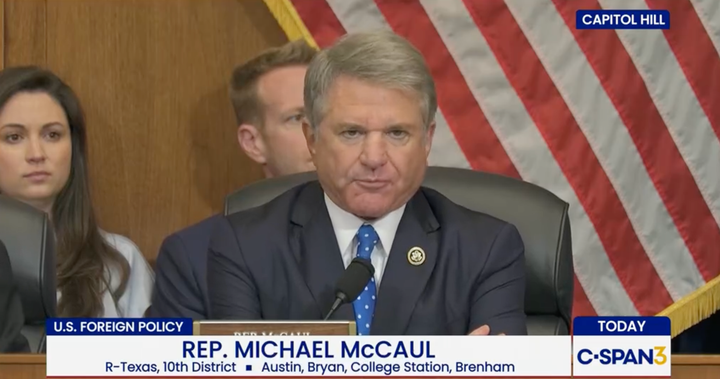
Texas Republican Michael McCaul helped give the federal government authority to take down drones deemed a threat, which the Federal Aviation Administration now cites in warning drone operators against flying near federal vehicles and other mobile assets. Since early 2025, he has disclosed six trades in the stock of leading counter-drone contractor CACI International, made in his wife’s accounts.
In early May, McCaul introduced a bill to authorize the National Guard to take down drones at large events including the World Cup. Five days later, CACI's chief financial officer told investors at a Bank of America conference that the company was seeing “very strong demand impulses related to sporting events and World Cup in particular.” The following week, Linda McCaul bought up to $100,000 in CACI stock. By mid-August, the stock had closed at an all-time high, nearly 40% above its price on the day of that purchase.
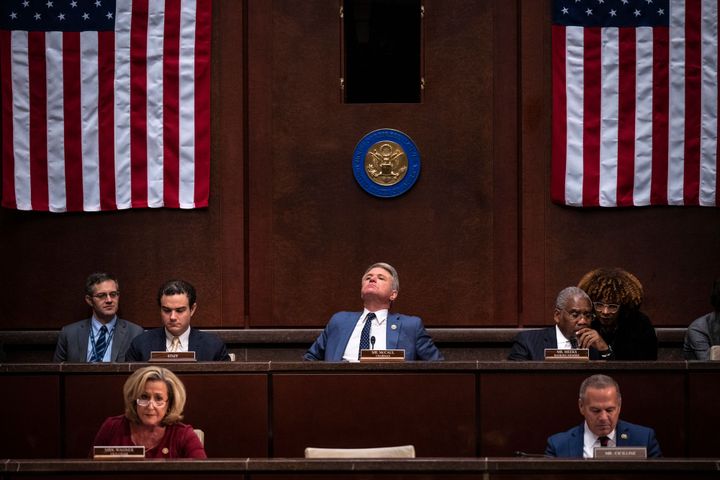
McCaul, a longtime member of the House Homeland Security Committee, introduced the bill that first gave the Department of Homeland Security and the Department of Justice the authority to intercept and take down drones they judge to be dangerous. It became law as part of the 2018 FAA Reauthorization Act.
Brendan Shields, a former CACI vice president, managed all of the committee's legislative efforts at the time, according to the Homeland Security & Defense Forum, a CACI-sponsored venue where McCaul frequently speaks. McCaul hired Shields in 2014, and Shields later followed him to the Foreign Affairs Committee as staff director.
CACI highlighted domestic drone defense as key to its multiyear growth strategy in early 2018. It lobbied Congress on the issue at the time, while DHS officials were testifying that federal law prevented them from countering threats from unmanned aerial systems.
In January, the FAA cited McCaul’s law as the legal basis for the Trump administration’s sweeping drone no-fly zone within 3,000 feet of DHS facilities and mobile assets. The policy was announced nine days after ICE agent Jonathan Ross killed Renée Good in Minneapolis.
“I grounded myself,” Minneapolis-based photojournalist Rob Levine told Sludge. “I eventually had to make decisions—am I going to go fly? Because at the time there were so many federal agents here, and 3,000 feet is a long way. They were driving around in unmarked cars, and as the FAA said to me, any mission could inadvertently violate the [Temporary Flight Restriction].”
Levine, who is represented by the Reporters Committee for Freedom of the Press, sued to challenge the blanket ban; in response, the FAA replaced it in April with an advisory memo that withdrew criminal liability, but warned drone operators to avoid flying near mobile assets of DHS and other agencies and maintained that drones can be intercepted or taken down. The advisory also cites McCaul’s law.
“We welcomed the withdrawal, but I believe the replacement advisory can continue to chill lawful newsgathering,” National Press Photographers Association general counsel Mickey Osterreicher told Sludge. “It warns that drones deemed to pose a credible safety or security threat may be disrupted, seized, damaged or destroyed, while advising operators to avoid proximity to government mobile assets. Journalists may have no reliable way to identify an unmarked government vehicle or anticipate its movements.”