As Congress faces growing pressure to regulate artificial intelligence, roughly one in five lawmakers’ households has investments in companies developing AI and supplying the infrastructure behind it, according to a Sludge analysis of congressional financial disclosures.
At least 106 members of Congress have disclosed that they, their spouse, or their dependent children hold stocks or other investments in AI developers, chipmakers, cloud infrastructure providers, data center companies, and specialized AI firms, with a total value of between $82.8 million and $325 million.
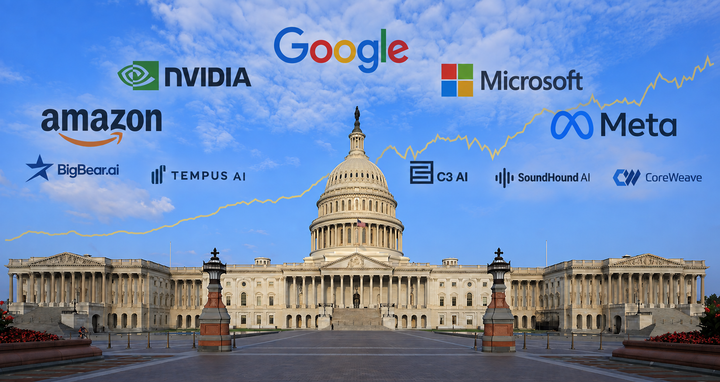
Most of the money is invested in large tech companies like Nvidia, Meta, and Alphabet. But lawmakers also report their households holding and trading shares in smaller publicly traded AI companies like BigBear.ai, Tempus AI, and C3 AI, as well as little-known private startups whose shares are unavailable to ordinary investors. Of the lawmakers reporting investments, at least 44 sit on committees with jurisdiction over legislation dealing with AI safety, consumer protections, semiconductor policy, and trade with China.
Although most large technology companies do not separately report all revenue attributable to AI, the technology has become a major source of their growth and investment. Microsoft, which has billions invested in OpenAI, says its AI business has surpassed $37 billion in projected annual revenue, while Amazon, a major Anthropic investor, says AWS’s AI business has exceeded $25 billion. More than 92% of Nvidia’s most recent quarterly revenue came from its data-center business, which is being driven by demand for AI computing infrastructure.
Over the past two years, Congress has proven unable to advance legislation placing AI under greater oversight. The failure to act was put in the spotlight this week after Jacob Coxon, a researcher who resigned from Anthropic, and Evan Hubinger, an alignment research leader at the company, issued warnings that AI systems could escape human control and potentially cause human extinction.
House Minority Leader Hakeem Jeffries called this week for “decisive congressional action immediately” to protect the public, while Republican House Speaker Mike Johnson rejected a moratorium and called on the frontier AI developers to self-regulate. The House then left for a recess scheduled to last through the midterms, leaving the AI issue unresolved amidst calls for urgent action.