Congressional Black Caucus

Black Caucus Groups Take $1.6 Million From Big Tech as Caucus Weighs Data Center Stance

By Donald Shaw,

Published on Oct 2, 2026   —   8 min read

MetaOpenAIGoogleamazonExelonEntergyDTEProgressive Policy InstituteMicrosoftTroy CarterTerri SewellSteve Horsford
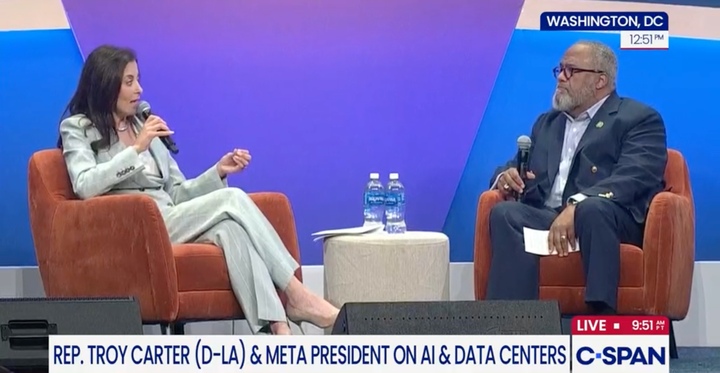
Rep. Troy Carter (D-La.) and Meta President and Vice Chairman Dina Powell McCormick speak at the Congressional Black Caucus Foundation's Annual Legislative Conference in Washington in September. (Screenshot via C-SPAN)

Summary

Beyond the money, the groups have hosted executives from Meta, Exelon and Entergy at their conferences, and caucus aides toured a data center with a think tank that has received funding from Google, Meta, and Amazon.

💡
Share this on X and Bluesky

As the Congressional Black Caucus works toward a consensus position on data centers, its members and the nonprofits they lead have brought the tech giants and utilities driving the data center boom into the discussion.

In August, the Congressional Black Caucus Institute hosted a policy conference in Mississippi and had DTE Energy's CEO speak on a panel about artificial intelligence. In September, the foundation's Annual Legislative Conference featured Meta and Microsoft executives promoting the economic benefits of data centers, and executives from utilities including Exelon and Entergy discussing energy costs and quality of life concerns. Between those events, CBC members sent their aides on a data center tour organized by the Progressive Policy Institute, a think tank funded by Big Tech giants Google, Meta and Amazon.

Caucus members are trying to reach a consensus on data center policy before the next Congress begins in January, according to attendees at the foundation’s September conference who spoke to CNBC. The discussion comes as the caucus weighs the economic opportunities of AI and data center construction with concerns about energy costs, environmental impacts, and effects on Black communities. Democrats are hoping to win control of the House and Senate in November, which would give the caucus's 62 members more say over legislation. 

A September University of Massachusetts Amherst poll found that 65% of respondents opposed construction of an AI data center in their community, including 76% of Democrats and 66% of Black respondents. Just 6% of Black respondents said they supported local construction, the lowest of all racial categories in the poll. Some congressional Democrats are calling for a national moratorium, including Rep. Frank Pallone (D-N.J.), the top Democrat on the House Energy and Commerce Committee. CBC Foundation board chair Terri Sewell (D-Ala.) is a co-sponsor of legislation introduced by Rep. Alexandria Ocasio-Cortez (D-N.Y.) that would halt new data center construction and expansion until Congress enacts safeguards addressing AI’s economic and environmental impacts.

Since the start of 2025, Amazon, Meta, Google and Microsoft have reported donating $1.27 million to the CBCF and $350,000 to the CBCI, according to the companies' LD-203 lobbying contribution disclosures. Amazon reported the most, $760,000, while Meta reported $500,000, split evenly between the two groups. Google reported $300,000 and Microsoft $60,000. In addition to Sewell, Reps. Troy Carter (D-La.), Steve Horsford (D-Nev.), Robin Kelly (D-Ill.), and Glenn Ivey (D-Md.) are CBC foundation board members. Rep. Bennie Thompson (D-Miss.) chairs the CBC institute, with Rep. Jim Clyburn (D-S.C.) as co-chair. Amazon’s LaDavia Drane and Exelon executive Colette Honorable also sit on the foundation’s board alongside the lawmakers.

Meta, Google, Amazon, and Entergy each have a representative on the CBC foundation's Corporate Advisory Council, along with Dell, Cisco and the Edison Electric Institute, the trade group for investor-owned utilities. The council advises the foundation’s board members, which includes multiple members of Congress, on policy, special initiatives, and leadership development, according to the foundation website.

The Congressional Black Caucus Foundation and the Congressional Black Caucus Institute did not respond to requests for comment.

Black communities, including some in those lawmakers’ districts, are fighting data center projects across the country. In Bessemer, Alabama, a majority-Black city in Sewell’s district, residents have packed council meetings to oppose a $14 billion data center campus whose planning involved a nondisclosure agreement signed by the mayor. QTS Data Centers, owned by Blackstone, confirmed in July that it was behind the project.

In Ivey’s Prince George’s County, Maryland, nearly 24,000 people signed a petition against a hyperscale data center proposed for the site of a shuttered mall, and the county council passed a two-year moratorium in July. Earlier that year, the NAACP and University of Maryland researchers issued a counter-report arguing that the county’s data center task force had overlooked cumulative impacts on Black and low-income residents and overstated job and tax revenue claims. The NAACP has launched a national campaign opposing what it calls "dirty data centers.”

The Black caucus makes up 29% of House Democrats and holds major sway over legislation. "Because of the large bloc of votes that we deliver, there's nothing that's going to move without us," Horsford told Bloomberg in 2024. 

Read This Post With a Free Trial

Unlock this post plus get our investigative reports with a two-week free trial subscription. Cancel anytime.

Start your free trial now

Already have an account? Sign in

Share on Facebook Share on Linkedin Share on Twitter Send by email

Unlock exclusive content with a free trial

Get unlimited access to in-depth investigative reports with a 14-day free trial. Cancel anytime.

Subscribe