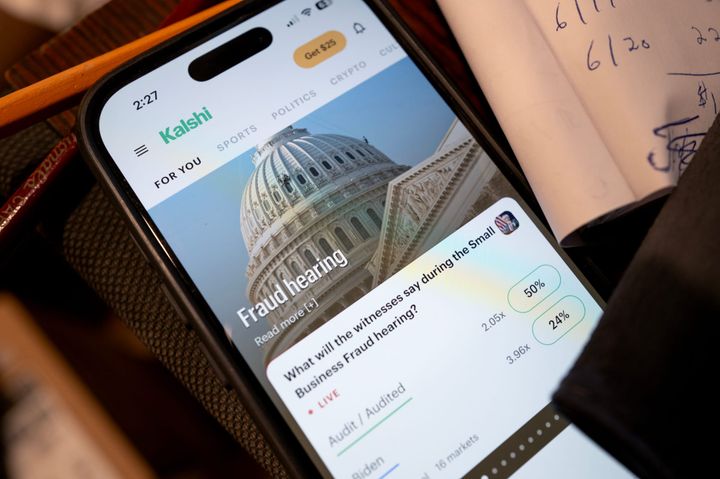
The Trump administration is going to bat for the prediction market industry, now tangled in lawsuits in at least 20 states, after giants Kalshi and Polymarket hired revolving-door lobbyists this year from both the Democratic and Republican sides of the aisle—and as Donald Trump Jr. holds investments in both companies.
In October 2025, New York gaming regulators sent a cease-and-desist letter to Kalshi, ordering the company to halt sports betting for state residents unless it obtains a gambling license. The order’s focus was on the booming sports-related wagers—called “event contracts” by the companies—that make up the vast majority of trading volume on Kalshi, and are similarly surging on Polymarket. Kalshi sued, arguing that only federal regulators could govern it, but in July the company lost bids to block the state’s order in federal court. New York Attorney General Letitia James then filed a lawsuit seeking to shut down Kalshi’s operations in the state and asking for $36 billion in penalties, alleging that the company was running “an illegal, unlicensed gambling operation.”
Kalshi’s next move was to appeal to its federal regulator, the Commodity Futures Trading Commission. The CFTC, under Trump, has proven to be extremely friendly turf for the industry: this year, the agency has sued at least nine states in defense of the prediction market industry, and has proposed a rule that would remove its own power to broadly block event contracts. On Aug. 11, the CFTC declared a market emergency and ordered Kalshi to keep bets flowing in New York.
In its suit, the CFTC is asking a federal judge to block New York from bringing its gambling laws to bear on federally-registered prediction markets. In a hearing this month, U.S. District Judge Lorna Schofield questioned the CFTC on its claim to have exclusive authority over the markets—a claim opposed by 44 state attorneys general in a letter to the agency in July. New Jersey has recently appealed to the Supreme Court to take up the legal tussle between the CFTC and state regulators; some analysts said its ask may not see movement until next year, due to other pending federal cases.
The CFTC’s legal support for Kalshi in its state legal battles isn’t the only regulatory issue in play. Last week, Kalshi asked the CFTC for permission to allow users to place bets on certain events with borrowed money, a practice known as “margin trading.” The request would cover wagers on economic, financial, political, and commercial events, and would not extend to the sports, culture, or “mention” markets that dominate Kalshi’s trading volume. Kalshi told CNBC that it is seeking margin trading approval to attract institutional investors to the platform.
Kalshi’s application to the CFTC will be considered while Donald Trump Jr. serves as a strategic adviser, a role announced in January 2025 that came with an equity stake then valued at $300,000 in the company. At the time, Kalshi had a valuation of under $2 billion, but it quickly ballooned: in May, it announced a $1 billion funding round at a valuation of $22 billion.
According to the New York Times, in March, the president’s son weighed in on the regulatory schism at a closed-door conference of Republican attorneys general, where he described prediction markets as robustly regulated at the federal level. In response to reports on Trump Jr.’s remarks to the GOP prosecutors, Kalshi wrote in a blog post last month: “He’s a fan of the industry and has his own views. He provides advice on marketing strategy, but he does not advise on regulatory matters.”
Kalshi did not respond to a Sludge request for comment on the potential conflicts of interest in its CFTC application for margin trading, in light of Trump Jr.’s financial stake in the company and the CFTC’s closeness to the prediction market industry.
Meanwhile, the CFTC initiated a rulemaking in June, largely focused on sports-event contracts, that would narrow its authority to block certain listings, moving away from categorical prohibitions to a rule where the agency “may determine” if an activity is contrary to the public interest.
By statute, the CFTC should operate with five commissioners, but the agency is running with just one: Chairman Michael Selig, a Trump appointee sworn into office in December. Selig has laid public claim for the CFTC to oversee prediction markets, and earlier this year the agency withdrew a Biden-era proposal that would have banned bets on sports and politics on prediction markets, saying it would craft new rules. Selig previously worked as outside counsel for technology investment firm Paradigm, and in a July 2024 letter, reported by InGame, argued that it was “arbitrary and capricious” for the Biden administration's CFTC to seek to prohibit sports event contracts.
A coalition of watchdog groups, including the Demand Progress Education Fund and financial industry watchdog Better Markets, pushed back against the CFTC’s proposal in a July letter to Chairman Selig and a rulemaking comment to the agency.
“The letter expressed our concern that prediction markets companies are getting away with disguising gambling bets as financial derivatives, so that they can evade the state gambling and tax law regimes that have been in place for decades,” Ella Fanger, corporate power policy advisor for Demand Progress, told Sludge. “The industry’s party line is that the CFTC has exclusive federal jurisdiction over regulating prediction markets that will preempt or override any state and tribal authority to regulate gambling. What we are offering as a counterline is that prediction markets offer the exact same bets as sports books, if you look at what the actual contracts are.”
Tens of billions of dollars flow through Kalshi and Polymarket in a month. In 2025, sports accounted for 89% of Kalshi’s fee revenue, and since July 2024 sports has made up around 80% of total trading volume on Kalshi and 39% on Polymarket. “So the argument that this is not sports betting is really thin, and yet the CFTC is validating it because it's the industry's wish list,” Fanger said.
Bipartisan Lobbying Buildup
Kalshi has ramped up its influence spending in Washington, including rolling out an emphatic ad campaign touting its implied differences with Polymarket, such as “We operate under U.S. law.” Through the first half of this year, Kalshi spent $990,000 on lobbying at the federal level, more than it spent in the entirety of 2025 and bringing its roster up to a half-dozen outside firms as it pushes to cement its regulators of choice at the CFTC.
In January, Kalshi opened a D.C. office, hiring John Bivona, the first Biden White House liaison at the Department of Homeland Security, and a former DCCC deputy national political director, to oversee lobbying efforts. In April, to bolster its support on the Democratic side and “deepen its relationships in D.C. and across the country,” Kalshi hired former Obama aide Stephanie Cutter as a policy adviser. A managing partner of the firm Precision Strategies, whose other clients include cryptocurrency industry group Stand With Crypto, Cutter came aboard to help manage Vice President Kamala Harris’ 2024 White House bid.
This year, Kalshi has staffed up with lobbyists at three outside firms to shape legislation on prediction market regulation. In January, the company tapped Resolution Public Affairs lobbyists Heather McHugh and Meghan Taira, two former legislative directors for Sen. Chuck Schumer. The following month, four revolving-door lobbyists at Squire Patton Boggs began lobbying for Kalshi, including Caren B. Street, who was previously chief of staff to former Rep. Karen Bass (D-Calif.) and executive director of the Congressional Black Caucus.
Starting July 1, a handful of lobbyists with bipartisan Forbes-Tate (now dubbed FTP) signed on for Kalshi, including Libby Greer and Cindy Brown, two board members with the “dark money” group Center Forward, which backs favored centrists in Congress through ad buys and super PAC expenditures.
Also on Kalshi’s roster, Jed Bhuta, a former House Democratic legislative aide, has lobbied for the company since 2024 through his consulting firm Tower 19. Matthew McNally, who was chief of staff to former Rep. Sean Patrick Maloney (D-N.Y.), began lobbying for Kalshi last year with the Democratic firm Intersection.
Maloney and former Rep. Patrick McHenry (R-N.C.), former chair of the House Financial Services Committee, were announced in January atop the Kalshi-founded Coalition for Prediction Markets, which defends CFTC oversight of prediction markets against the states’ litigation. “We have a great cop on the beat,” Maloney said of the agency at a March event at the Milken Institute’s Future of Finance. The trade group, whose members at launch also included Crypto.com, Robinhood, Coinbase, and Underdog, lobbied the House and Senate in the second quarter on regulatory frameworks with the bipartisan firm Invariant. A spinoff firm, Determinant, led by veteran Democratic lobbyist Mary Beth Stanton, registered to lobby for the coalition this summer.
Boosting its Republican side, Kalshi hired Tony Hanagan, a former senior Republican floor assistant, as head of congressional affairs in May. Superlobbyist Jeff Miller of Miller Strategies, a top Trump campaign fundraiser, was tapped to lobby for Kalshi in February. Brian Quintenz, a former CFTC commissioner when Kalshi was approved as a contract market in 2020, has sat on the company's board since 2021. He was nominated by President Trump to lead the agency last year, before his nomination was withdrawn.
Around two dozen bills have been proposed this year in Congress to regulate prediction markets, according to the Washington Sun, and they are largely stalled. One bill that Kalshi has publicly supported, from centrist Rep. Josh Gottheimer (D-N.J.), would require prediction markets and sportsbooks to use facial recognition technology for age verification before a user can place a wager.
“There have been generations of states and tribal authorities developing community and mental health protections to address the very real risks that come along with speculative activities,” Fanger said. “Prediction markets, on the other hand, are operating in a wild west of being able to, for instance, aggressively market to young people on college campuses, and in states where sports betting is illegal under the age of 21. And they're doing so not being bound by the same consumer protection frameworks.”
Fanger mentioned areas like loss limits, advertising restrictions, and gambling risk disclosures as insufficiently addressed in prediction markets. “These are risky activities, and the industry is being given a blank check to market to people of all ages and get them hooked at a young age,” she said.
Trump Jr.’s Polymarket Play
1789 Capital, the investment firm where Trump Jr. is a partner, first announced its investment in Polymarket in August 2025, an amount reportedly in the double-digit millions, and brought on Trump Jr. as an adviser. Soon after, the CFTC put out a no-action letter regarding event contracts from two Polymarket-acquired LLCs, and Polymarket readied to launch in the U.S. In comments this year to the CFTC, Polymarket also argued that the agency has exclusive jurisdiction over prediction markets. Recently, 1789 Capital led a $1 billion funding round for Polymarket, piling in an additional $300 million to bring its stake to around $500 million at a valuation of $21 billion.
Polymarket’s parent company, Blockratize, hired its first federal lobbyists in March of last year with the firm Advocus Partners: Trump advisor David Urban, and former CFTC senior policy adviser Keaghan Ames. They’ve been joined this year in lobbying Congress, the CFTC, the Securities and Exchange Commission, and the Treasury Department on “development of digital asset policy and information markets” by Andrew Lewin, a former Democratic Hill staffer. Blockratize's lobbying spending since the start of 2025 has topped half a million dollars.
Kalshi’s request to offer margin trading—also known as “leverage”—on certain event contracts can be approved without a full CFTC rulemaking, meaning it could be in effect after its 45-day receipt window, potentially sometime around Nov. 9. The CFTC rulemaking on prediction markets, rewriting the agency’s implementation of a Dodd-Frank Special Rule on the term “gaming” and event contracts, would take effect 60 days after a final rule is adopted and published; the agency has not yet publicized a date for the final rule to be released.
“This CFTC rule would accept the industry's claims that event contracts are derivatives, when in reality they're gambling by another name,” Fanger said. “We believe that the CFTC should respect the authority of states to regulate gambling and to protect consumers from dangerous gambling platforms.”
Today's newsletter is free — if you value this conflict-of-interest reporting on multibillion-dollar companies and their regulatory wish lists, sign up as a paid Sludge subscriber for $100-year and get full access to all our stories. 🔎