The Environmental Protection Agency quietly greenlit the use of three pesticides containing toxic “forever chemicals” last Tuesday. The public officials who oversee their regulation previously worked as lobbyists for trade groups representing the agrichemical firms that applied for their approval.
Since November, the EPA has authorized five PFAS pesticides to be sprayed on crops nationwide, marking the latest in the White House’s deepening embrace of the chemical industry’s agenda—even as it ruptures the Make America Healthy Again coalition that helped elect it.
PFAS are known as “Forever Chemicals” because they are built around the strongest bond in organic chemistry—fluorine and carbon—which makes them extremely persistent in nature. They have been linked to a broad range of health maladies and have contaminated waterways throughout the country. A 2024 study found these compounds are increasingly used in U.S. pesticides, now composing around 14% of their active ingredients.
“The reason we’re worried is because this went from being the exception to being the rule,” Center for Biological Diversity Environmental Health Science Director Nathan Donley, a co-author of the study, told Sludge. “PFAS pesticides were very rare 20 years ago, and now they make up nearly every new pesticide approval.”
The EPA claims that the recently approved pesticides do not qualify as PFAS because they are single-fluorinated carbon compounds rather than composed of at least two fluorinated carbon atoms. This narrow definition has been pushed by the chemical industry, as Sludge has previously reported. It excludes thousands of substances that most scientists consider to be PFAS.
Internal EPA email records obtained by the Center for Biological Diversity under the Freedom of Information Act and reviewed by Sludge show the pesticide office’s adoption of the definition was steered by political appointees, including former chemical industry lobbyists. In early November 2025, the EPA posted a webpage that stated: "EPA has not adopted a particular definition for its Office of Pesticide Programs." By November 26, that language had been replaced with a declaration that single-fluorinated-carbon compounds "are not PFAS."
The email records show the page was personally edited by EPA administrator Lee Zeldin, who earlier lambasted news reports of the administration’s first PFAS pesticide approvals as “Fake News.” The effort was coordinated by the head of EPA’s pesticide office, Kyle Kunkler—former senior director of government affairs for the pro-pesticide American Soybean Association—and EPA Deputy Associate Administrator for Public Affairs Cora Mandy, whose spouse, Hunter Morgen, is a registered lobbyist for PFAS manufacturer 3M at lobby firm Ballard Partners, where he has reported lobbying the EPA on environmental regulatory issues on 3M’s behalf. Ballard is also a top lobbyist for Bayer, the producer of newly approved PFAS pesticide Diflufenican.
“You can’t expect someone to work in the public interest when their career has been to lobby for polluting industries,” Donley said. “The EPA is literally being run by chemical industry lobbyists right now, who are prioritizing their industry instead of the American people. And it’s all being done under the guise of making America healthy. People are being gaslighted plain and simple.”
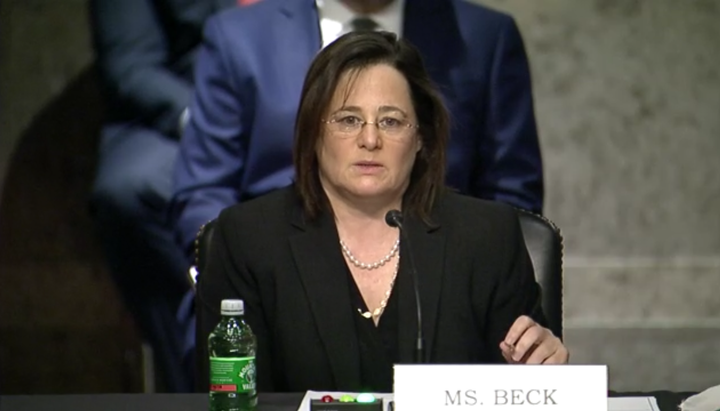
At least five other EPA officials on the email chain have financial ties to the chemical and pesticide industry. They include deputy assistant administrator Nancy Beck, who previously worked for law firm Hunton Andrews Kurth, which provides PFAS and pesticide litigation defense, as well as the American Chemistry Council, which represents Bayer and the other PFAS pesticide manufacturers; assistant administrator Doug Troutman, former co-CEO of the American Cleaning Institute, which represents PFAS pesticide producers BASF and Dow; Senior agriculture advisor Turner Bridgforth, a former lobbyist for pesticide manufacturer Corteva; deputy chief of staff Michael Abboud, whose spouse is 3M’s former director of government affairs; and senior advisor Kirby Tyndall, a former senior toxicologist with chemical industry consultant GSI Environmental, whose clients include BASF, the American Chemistry Council, and PFAS manufacturer trade group the FluoroCouncil.
On the same day the webpage went live, a paper funded by pesticide industry group CropLife America was submitted to a scientific journal arguing that single-fluorinated-carbon pesticides should not be regulated as PFAS, citing the new EPA language published that day. CropLife has a history of shaping pesticide policy language—including pushing to remove pesticides from the MAHA Commission’s September report—and it has waged an extensive lobby campaign to block state regulations through adoption of the narrow PFAS definition. The lobby group’s CEO, Alexandra Dunn, oversaw pesticide regulations as assistant EPA administrator in the first Trump administration. At the time, she and Lynn Dekleva—a senior official in EPA’s chemical safety office and former American Chemistry Council senior director—worked with chemical industry representatives to edit the EPA’s language for chemical safety reviews.
The EPA and the lobby group did not answer Sludge’s inquiry as to whether they coordinated on the website change. An agency spokesperson noted the Biden administration also used the narrow PFAS definition and similarly registered a fluorinated-carbon pesticide, Fluazaindolizine, in 2023. “By the Biden administration's own regulatory standard, they are not PFAS,” the EPA spokesperson told Sludge.