The two giant super PACs closely tied to Republican leaders in the House and Senate are relying on billionaire donors, the fossil fuel industry, cryptocurrency firms, and Big Tobacco to bankroll their defense of Congress.
At least 47% of the combined haul of the Senate Leadership Fund (SLF) and the Congressional Leadership Fund (CLF) has come from billionaires—at least $133.5 million—according to a Sludge analysis of Federal Election Commission data from the start of 2025 through March 2026. The billionaires include reclusive President Trump megadonor Timothy Mellon, casino mogul Steve Wynn, Republican megadonors Christopher and Jude Reyes, poultry magnate Ronald Cameron, and cryptocurrency tycoons the Winklevoss twins. It's possible that more billionaires have donated to the SLF and CLF through their "dark money" affiliates, which hide the names of donors from the public.
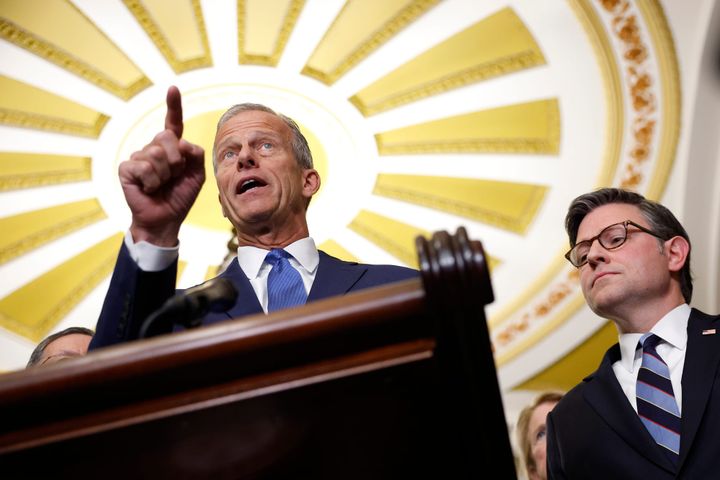
The SLF and CLF were the top-spending outside groups nationwide in the 2022 midterms—though this time around, many more super PACs are loaded up with record amounts of cash to spend. The groups, aligned with Senate Majority Leader John Thune (S.D.) and House Speaker Mike Johnson (La.), spend heavily on attack ads against Democrats and independent expenditures supporting Republicans each cycle.
More than half of the disclosed donations from billionaires this cycle to the SLF and CLF have come from just three Trump allies. The top SLF donors have been pro-Israel megadonor Miriam Adelson (with a $30 million gift on March 11), investor Paul Elliott Singer ($14.5 million), and Elon Musk of government contractor SpaceX, totaling $10 million. On the House campaign side, the CLF’s largest known donations so far have been $10 million apiece from Adelson and Musk, followed by $8 million from Singer.
Earlier this month, the SLF announced a massive spending plan: $342 million to hold control of the Senate and flip Democratic-held seats in Georgia, Michigan, and New Hampshire. The SLF touted the eight-state plan as its largest-ever spending campaign, encompassing television and digital ads, mail, and other GOTV operations. Maine Sen. Susan Collins can expect to benefit from an initial $42 million in re-election support from SLF.
Overall this cycle, the SLF has raised more than $175.4 million, and the CLF has raised over $110.1 million, counting transfers from their dark money nonprofits. The SLF’s nonprofit affiliate, One Nation, has given it nearly $46.5 million so far this cycle, and the CLF’s sibling American Action Network has kicked in $24.3 million. Super PACs on both sides of the aisle are increasingly using nonprofits to funnel in tens of millions of dollars without disclosing donors’ identities, a trend Sludge has detailed over the past several cycles.
Meanwhile, Democratic campaign donors are opening their wallets to take back control of the House and challenge Republicans in Senate battleground states. When FEC filings for the first quarter of 2026 dropped last week, they showed that Democrats in key Senate and House races raised hefty amounts of campaign cash, headlined by a record-setting $27 million haul in Q1 for James Talarico in Texas. Donations on the Democratic platform ActBlue, largely in small-dollar amounts under $200, set a new record for the first quarter of a midterm year. In a set of 16 House races rated as competitive, Democratic candidates outraised Republican incumbents in 13 of them, according to Roll Call.
But Democratic campaigns’ temporary advantage in direct fundraising is blunted by the war chests of GOP super PACs. Republicans hold a strong edge in outside spending cash reserves, as of this snapshot of the 2026 midterms. The largest super PAC, President Trump’s MAGA INC, finished March with a whopping $312.3 million in cash on hand ready to tumble out in support of Republicans starting around Memorial Day. And tallying up cash on hand for the four party-tied super PACs, the SLF’s $166.4 million and the CLF’s $91.4 million combine to be twice as much as the Democrats' Senate Majority PAC's $74.8 million and House Majority PAC’s $53.6 million.
Fossil fuel industry donors have given at least $28.8 million to the SLF and CLF, according to this analysis, to help their allies on energy policy in Congress hold control of both chambers.