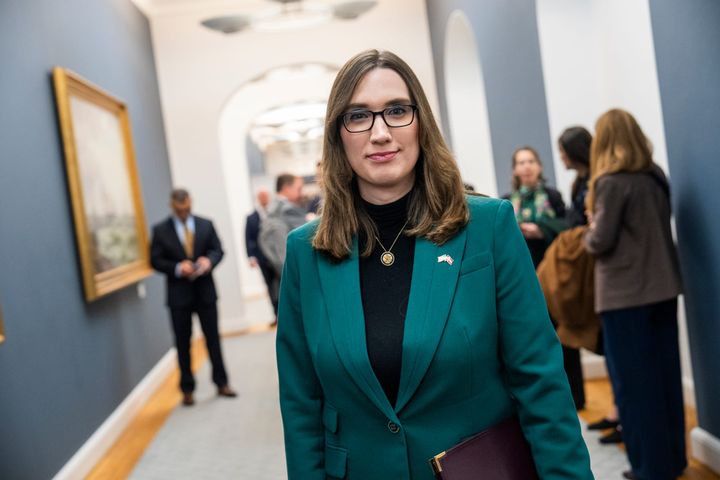
House Democrats elected Rep. Sarah McBride last week as a co-chair of the House Democratic Policy and Communications Committee, where she will help shape the incoming majority’s message on the cost of living. McBride is the first openly transgender member of Congress elected to a leadership post. After the vote, she said House Democrats would be “laser-focused on lowering costs.”
In her first term since joining Congress in 2025, the Delaware Democrat co-sponsored or voted for at least 11 Republican-led bills that would loosen financial regulatory rules, including measures restricting states’ ability to enforce interest rate caps, reducing scrutiny of bank mergers, and opening more workplace retirement plans to private equity. Her campaign and leadership PAC took in at least $432,000 from finance industry PACs and individuals in the 2025–26 election cycle through Oct. 14, a Sludge review of Federal Election Commission filings found.
Three Wall Street billionaires gave McBride’s campaign the legal maximum $7,000 apiece: Apollo Global Management CEO Marc Rowan, Lone Pine Capital founder Stephen Mandel, and Baupost Group CEO Seth Klarman. Two employees of the trading firm Jane Street accounted for $24,000, and JPMorgan Chase employees gave $20,210, most of it from the bank’s vice chair and general counsel. The PACs of Capital One, the American Financial Services Association, the American Bankers Association, and many other finance companies and trade groups also made donations.
McBride’s office did not respond to questions about her support for the bills or the contributions from the finance industry.
When McBride took office, she said she wanted to pursue “common sense solutions” to make it more affordable to raise a family. She stressed bipartisanship, and nine of the 10 bills she introduced in her first term had a Republican cosponsor. On July 21, she introduced a bill with Rep. French Hill (R-Ark.) to expand a tax credit for small businesses that make their workplaces more accessible to people with disabilities. That same day, McBride also voted for Hill’s banking deregulation bill, which would eliminate federal antitrust reviews of many bank mergers.
Another Republican-led finance policy bill McBride backed drew opposition from 18 Democratic attorneys general. In a Nov. 9 letter, they urged House leaders to block the bill, warning that it would make it easier for online lenders to charge triple-digit interest rates. McBride had signed on in May as a cosponsor of the American Lending Fairness Act, introduced by Rep. Warren Davidson (R-Ohio).
Under a 1980 law, state-chartered banks can lend across state lines at the interest rates allowed where the bank is located, even if the borrower’s state has a lower cap. Congress gave states a way to opt out of that rule, and Colorado in 2023 and Oregon in 2026 passed laws involving that provision to apply their own caps to loans made to their residents.
Oregon Democrats touted their law as part of their affordability agenda this year. It was designed to keep online lenders from using out-of-state banks to get around Oregon’s 36% cap on consumer finance loans. The bill that McBride co-sponsors would amend the 1980 law so that states could only apply interest rate caps to loans made by banks and credit unions that the state charters itself. An out-of-state bank could still lend at rates allowed in its home state.