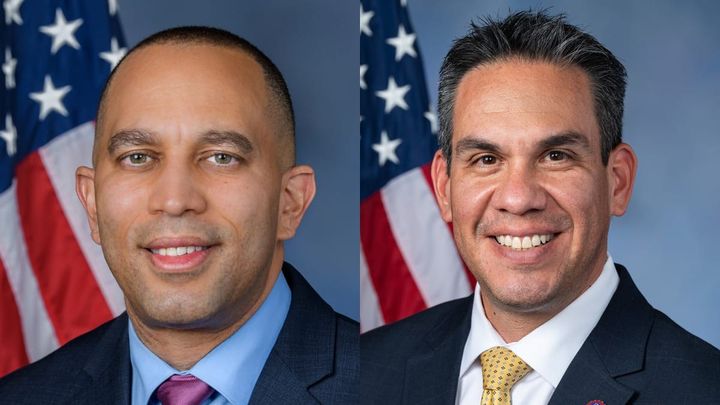
As a record number of lawmakers pledge to reject corporate PAC money, two Democrats expected to lead the next House session—Pete Aguilar and Hakeem Jeffries—rank as their party’s top two recipients of that money in the chamber this election cycle, a Sludge review of Federal Election Commission filings found.
Aguilar, the House Democratic Caucus chair, reported $1.42 million in corporate PAC contributions to his campaign, from January 2025 through Oct. 14, 2026. House Democratic Leader Jeffries ranked second in corporate PAC fundraising with $1.32 million, followed by Rep. Richard Neal of Massachusetts with $1.27 million. Democratic Whip Katherine Clark’s campaign reported receiving $1.11 million, placing her fourth. Among all House members, only two Republicans—Ways and Means Chair Jason Smith of Missouri and Energy and Commerce Chair Brett Guthrie of Kentucky—reported more.
Of the $2.8 million total that Jeffries’ campaign received from political action committees, nearly half came from corporate PACs. For Aguilar, corporate PACs accounted for 57% of the $2.5 million he raised from PACs. The rest came from PACs of trade associations, labor unions, membership groups, and ideological organizations.
House Democrats have scheduled their leadership elections for Wednesday, Nov. 18, with Jeffries seeking the nomination for speaker, Clark running for majority leader, and Aguilar seeking the majority whip position. Aguilar has backed Jeffries, saying in a press conference there is “no question he will be the next speaker,” as the top-ranking House Democrat is facing pressure from progressive activists who are urging Democrats to choose another speaker.
At least 100 members of the incoming 120th Congress have pledged to reject corporate PAC money, according to End Citizens United, which launched the “No Corporate PAC” pledge in 2017. The previous high for pledge takers was 73 in the 118th Congress. ECU President Tiffany Muller said in a statement that the growing number of pledge-takers have “the potential to fundamentally change the relationship between elected officials and corporate special interests.”
The congressional offices of Jeffries, Aguilar, and Clark did not respond to requests for comment.