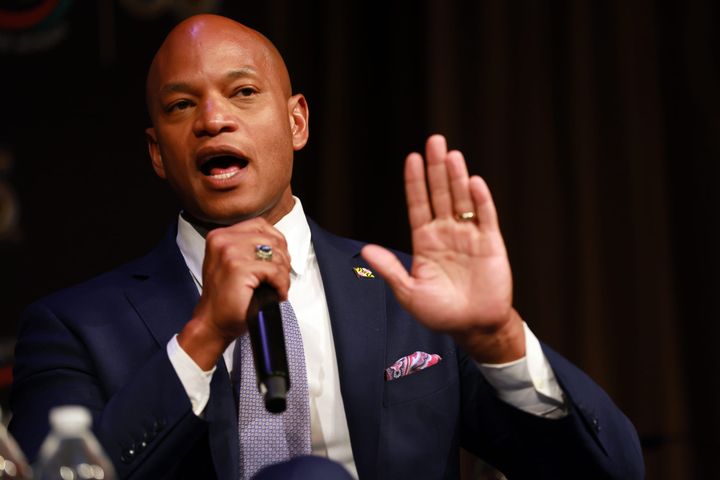
Maryland Gov. Wes Moore won’t say whether he received a bonus while working as an investment banker at Citigroup after the company was saved by a government bailout during the 2008 financial crisis that the bank helped precipitate.
Asked by Sludge whether he received a bonus payment, Gov. Moore’s spokespeople declined to address the question. Ammar Moussa, senior press secretary with the Maryland governor’s office, spoke with Sludge on the phone but would not speak on the record on Sludge’s inquiries, which also included the following: Moore’s opinion on the terms of the Citigroup bailout; his views on Lina Khan, former chair of the Federal Trade Commission; and matters stemming from the governor’s financial disclosure. In ending the phone call, Moussa said he would get back to Sludge when he could.
It was not the first time Moore has declined to answer the question of whether he accepted a Citi bonus. In late April, Moore’s spokesperson ducked the same question from Axios.
Moore, who is running for re-election as governor and has been rumored to be in the mix as a potential 2028 White House candidate, worked at Citigroup from September 2007 until April 2012, becoming a vice president at the company in 2010.
Citigroup gave out $5.3 billion in bonuses in 2008, the year its taxpayer-funded bailout support began, according to a report from the New York attorney general’s office. 738 employees received bonuses of at least $1 million, according to the report.
In 2008, Andrew Cuomo, then attorney general of New York, called for executives at Citi and other bailed-out banks to turn down or return their bonuses, arguing that taxpayers had been put on the hook for the banks’ toxic assets. Despite the banks’ claims defending their bonuses, Cuomo said, the state’s report found no evidence that employee compensation was tied to financial performance. The just-inaugurated President Obama called the Wall Street bonuses “shameful” and “the height of irresponsibility,” since the billions in government funding could have infused state budgets just as unemployment driven by the financial crisis hit its highest rates in decades.
The securities industry dished out an estimated $18.4 billion in bonuses for 2008, according to figures from the New York comptroller’s office.
Over the past year, Moore has been feeding his national profile through trips to the early primary state of South Carolina and swing states like Michigan and Pennsylvania, though he says he’s “not running” for the White House in 2028. Last summer, Moore made his second trip as governor to what is dubbed “summer camp for billionaires,” the Sun Valley Conference in Idaho, where CEOs in attendance included Jeff Bezos of Amazon, Mark Zuckerberg of Meta, Sam Altman of OpenAI, Dara Khosrowshahi of Uber, and Rupert Murdoch, chairman emeritus of Fox Corporation. His 2023 trip to the conference was in his role as national finance chair of the Democratic Governors Association.
Citi, then the largest U.S. bank and one with a history of subprime lending, played a significant role in packaging mortgage-backed securities and keeping the risky assets off their balance sheets. In November 2008, when Citi received its first bailout, the company announced plans to slash 52,000 jobs—the largest cuts recorded since 1993 by the firm Challenger, Gray & Christmas—and raised rates for some credit card holders.
During Moore’s years working at the bank, Citigroup was also subject to billions of dollars in penalties for violations of investor and consumer protections. In 2014, the Justice Department announced a $7 billion settlement with Citi—including a $4 billion civil penalty for the bank, at the time the largest of its kind—due to its investor misrepresentations, which helped set off the Great Recession.
In the years after the bailouts, financial industry watchdogs argued that the terms of the government’s rescue were too generous to the banks, their investors, and creditors. Bondholders lost almost nothing, and the official November 2008 announcement made no mention of creditors taking a haircut.
Sheila Bair, the former chair of the Federal Deposit Insurance Corporation, argued that Citigroup should have been restructured into “a good bank and bad bank,” where the losses on the bank’s toxic assets would be absorbed by Citi’s shareholders and bondholders, more akin to a bankruptcy proceeding. Economists Paul Krugman, Joseph Stiglitz, and others argued for a phase of nationalizing financially-shaky banks and imposing losses on bondholders.
Moore’s spokesperson also did not respond to Axios’ recent question about whether he thought the federal bailout of Citigroup was justified.
The total government exposure to Citigroup through loans and funding support reached an eye-popping $517 billion by January 2009. The Center for Economic and Policy Research penciled out in a 2009 briefing that the implicit government subsidy behind the “too big to fail” banks was worth around $34.1 billion a year for 18 of the biggest bank holding companies, those with more than $100 billion in assets.
Sludge asked Moore’s spokesperson if the governor thought the Citigroup bailout was appropriately designed, in light of Bair’s argument that creditors could have taken losses to address the “moral hazard” of the bailout, whereby the federal government protected the company from the consequences of its risky loans. No response was given for this story.
Since taking office, Moore has extensively raised funds for his Maryland re-election through $6,000 maximum campaign contributions from executives, consultants, and large companies including the Baltimore-headquartered CFG Bank, according to the Baltimore Sun.
Antitrust Enforcement in the Crosshairs
Moore suggested in an August 2024 CNBC appearance that a Kamala Harris administration would move away from the regulatory approach championed by Lina Khan, who had reinvigorated antitrust enforcement at the FTC and elsewhere across the federal government. Moore, a close ally of Harris, was asked by journalist Andrew Ross Sorkin about moving away from Khan, as “there have been a lot of calls from the donor class” to try to have “a different type of regulatory regime that might be more open to transactions and dealmaking.”
“Do you think that we are going to hear about a shift in terms of her regulatory views, and do they really differ from President Biden,” Sorkin asked.
"I think we will, and I think we have to,” Moore replied. He said that a Harris administration would, in addition to supporting small businesses, be “also making it easier for our large industries to be able to compete.” He went on, “As the vice president is thinking about a future-facing administration, there are going to be different dynamics that are going to require different philosophies.”
Moore’s comments on Harris’ antitrust posture came at a key juncture in the election year, with billionaires like Reid Hoffman and CEO Aaron Levie of Box agitating in the media for a Harris administration to turf Khan out and stand down scrutiny of corporate concentration. Moderate Sen. Jacky Rosen, who won re-election that cycle in Nevada, was among the Democrats who went in the other direction and publicly embraced Khan’s views on regulating corporate power, and House Judiciary Committee ranking member Jerrold Nadler (N.Y.) praised the $430 million that Khan’s FTC returned to consumers.
Khan was at the fore of the Biden administration’s revival of antitrust enforcement, alongside officials like Jonathan Kanter of the Department of Justice’s Antitrust Division, who had been planning an overhaul of its review of bank mergers, and Rohit Chopra of the Consumer Financial Protection Bureau, who had cracked down on “junk fees” like those paid by bank customers. Khan and Kanter’s agencies reviewed a record-high 3,500 proposed mergers in fiscal year 2021, seeking to apply pro-competition laws and curb the trend of corporate concentration. Khan’s antitrust framework was distinguished by her law school article making a case for more robust antitrust challenges to large companies like Amazon and Facebook.
Moore’s CNBC appearance prompted journalist Ryan Grim to ask Moore a focused follow-up question, if a Harris administration would remove Khan. His spokesperson’s response did not directly answer Grim’s question, which Grim confirmed was the extent of what Moore was willing to say about Khan’s record.
In April, CNN asked Moore about his views on Khan, as 2028 Democratic presidential hopefuls are seeking her guidance on economic policy and affordability issues, and a spokesman said, “He doesn’t have thoughts about her one way or the other.”
Sludge asked Moore’s spokesperson for his views on Khan’s four-year tenure at the FTC, after CNN’s question on the same front. Moussa would not comment on the record.
Wall Street Network
In his 2015 memoir, Moore wrote of his time at Citi that he “wasn’t in love with banking” and that he joined because it was the “easiest choice” after his time as a Rhodes Scholar, White House fellow (assisting then-Secretary of State Condoleezza Rice), and U.S. Army officer in Information Operations. Moore’s public statements about his Army deployment to Afghanistan—and his insinuations that he experienced direct-fire combat there—are coming under greater scrutiny by veterans, according to the investigative partnership Spotlight on Maryland. Moore and his then-superior officer, Lt. Col. Mike Fenzel, have not provided the reporting partnership with evidence that Moore led paratroopers in combat.
Moore’s career before elected office had him rubbing shoulders with finance industry executives. In 2017, he was tapped as CEO of the Robin Hood Foundation, a New York City anti-poverty nonprofit with wealthy board members like the Wall Street CEOs of asset manager BlackRock, private equity giant Blackstone, J.P. Morgan Chase Wealth Management, and others. In a 2015 paper, the advocacy campaign Hedge Clippers wrote that the Robin Hood Foundation’s founder, hedge fund mogul Paul Tudor Jones, oversaw through his deputies the trade association Managed Funds Association, which lobbies against closing the “carried interest” tax loophole that lowers the income tax rates paid by investment managers. As of its most recent tax return, the deep-pocketed Robin Hood Foundation drew income from its $334.5 million in assets and raised an additional $183 million in 2024.
While at the foundation in 2020, Moore joined the board of directors of the Baltimore-based company Under Armour, led by billionaire CEO Kevin Plank. After Donald Trump’s election win in 2016, Plank spoke effusively about the new “pro-business president” and joined Trump’s American Manufacturing Council.
Also while at Robin Hood, Moore joined the board of the Chicago-based cannabis goods and dispensary company Green Thumb Industries, serving there from 2018 into 2022. In 2021, the company came under federal investigation for pay-to-play practices as it sought Illinois operating licenses. Moore stepped down from the two companies’ boards after winning the governor’s office in 2022. His staff moved to set up a blind trust for Moore’s assets including his stock in the two companies: Under Armour shares worth around $460,000, and Green Thumb Industries shares with more than $1.4 million, according to the Baltimore Sun. The total transferred into Moore’s blind trust in 2023 was $2.5 million.
Additional assets are held outside of Moore’s blind trust, as detailed in his Maryland financial disclosures as a candidate and in office. For 2025, Moore’s latest disclosure lists stakes in 20 companies, largely in what appear to be real estate LLCs with names like Cityline Acquisition LLC that are based in Lakewood, New Jersey, along with literary and speaking companies owned wholly by Moore. With stakes typically varying between 3% and 9%, the total value of Moore’s holdings in LLCs is worth more than $1 million and up to $6 million.
Moore was also holding stakes in venture capital funds when he forecast a regulatory change under a Harris administration. As of 2025, the governor holds a partnership interest worth more than $250,000 in the Vibranium Ventures Fund I LLC based at 300 International Drive in Baltimore, the address of the Four Seasons Hotel Baltimore, which includes luxury condominiums. Maryland state records show that LLC failed to file reports and was forfeit in 2022, while Moore held his stake; the company was reinstated by Maryland in October 2024. The reinstatement form lists the company’s full address as a suite at the Four Seasons’ address. The fund’s general partner listed is Luke Cooper, the name of a Baltimore-based VC investor who is currently a venture partner at Preface Ventures and a founding managing partner at Latimer Ventures.
Moore retains shares in a special purpose acquisition company he helped to form, Focus Impact Acquisition Corp., though he did not list the asset on his disclosure until the Baltimore Sun inquired about the SPAC in October 2022. The vehicle raised more than $200 million to invest in companies, according to filings with the Securities and Exchange Commission. In 2025, Moore disclosed that he sold an under-3% stake in Zeal Capital Management, a company valued at more than $10 million, for between $5,000 and $9,999. The Washington, D.C.-based VC company Zeal Capital Partners, which says it invests in diverse management teams, had $186 million in assets under management.
Moore’s spokespeople did not respond to questions about the Vibranium Ventures Fund and its holdings, or the nature of his sold-off stake in Zeal Capital Management.