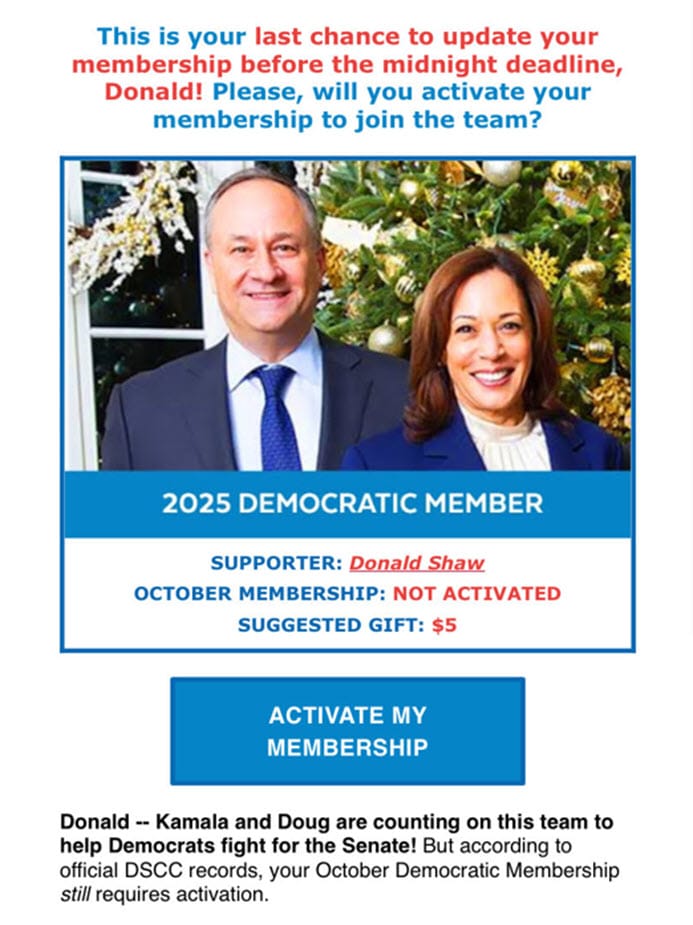
“This is your last chance to update your membership before the midnight deadline, Donald!” blares an Oct. 11 fundraising email from the Democratic Senatorial Campaign Committee (DSCC), featuring Kamala Harris and Doug Emhoff’s smiling faces and urging me to “activate” my Democratic membership with a $5 donation. It’s just one of the many urgent fundraising appeals I’ve received recently from the Democrats saying that I’m up against an expiring deadline to join “the team.” Other emails from the DSCC and DCCC received last month claim that anything I donate will trigger a match of up to 400% to help elect more Democrats, though the emails and landing pages do not explain how those matches would work.
These Democratic fundraising tactics have come under fire for scamming donors instead of working to build a real movement. More than a hundred Democratic strategists warned in a December 2024 letter to ActBlue that deceptive pressure tactics like fake deadlines risk alienating the party’s base. Even former Obama adviser Dan Pfeiffer argued in a blog post this summer that the Democrats’ consultants are “incentivized to burn through email and text lists in search of short-term returns,” with little regard for message quality, but rather “just how much cash can be extracted.”
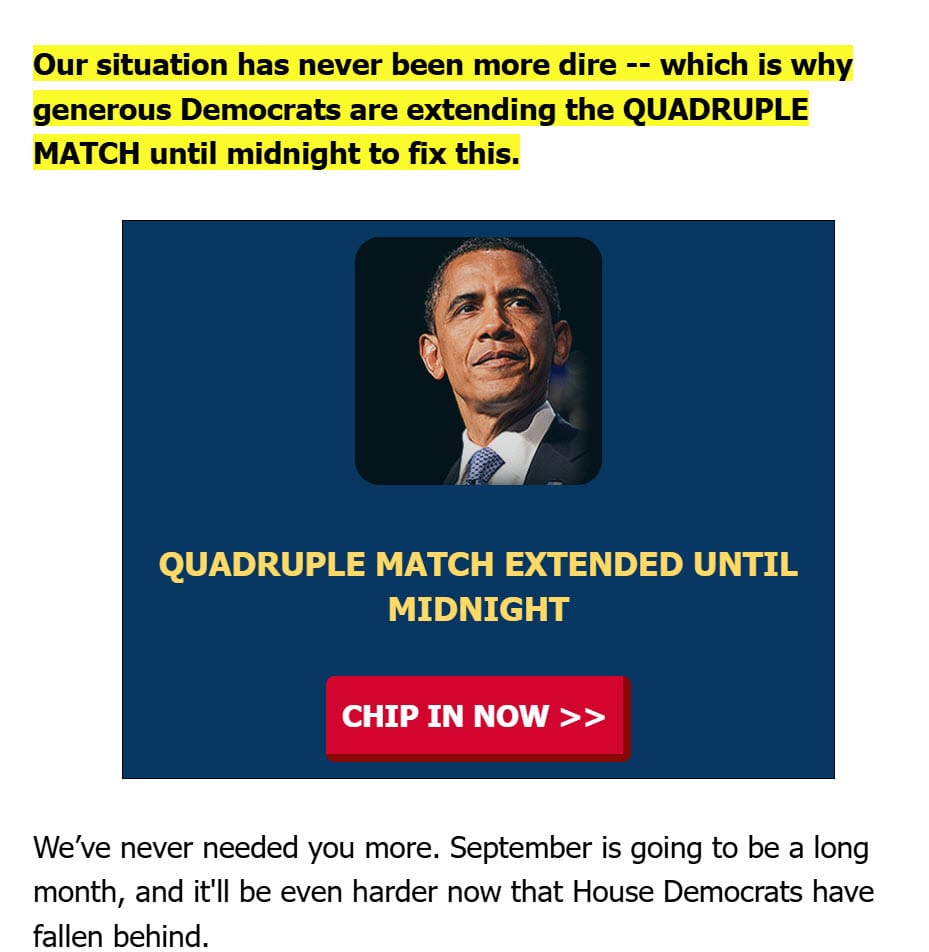
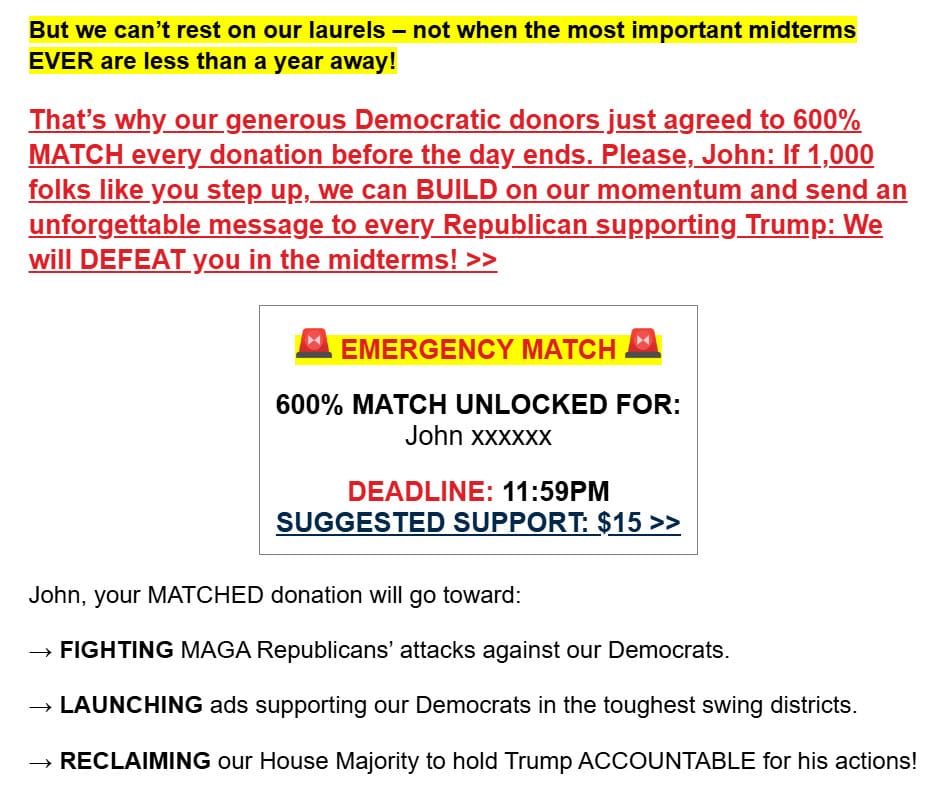
Emails from Democratic Party Groups and PACs since the ActBlue policy update banning references to fake memberships and matches
Tougher rules had been sought for years by digital organizers, who lodged complaints that the barrage of unverifiable, all-caps fundraising emails and texts burned their lists. A new analysis from early August by Stanford political scientist Adam Bonica found that one network of PACs, under the firm Mothership Strategies, passed along only 1.6% of the money raised to Democratic campaigns.
In response, ActBlue—the tech platform that powers most Democratic fundraising—updated its account use policies in August to prohibit solicitations on its platform that “include false or unsubstantiated claims,” such as “references to fake voting records,” insinuations about “non-existent memberships or subscriptions,” or unverified donation matches.
But enforcement of the new policies appears to be lax. A source at ActBlue told Sludge that the company has taken action against dozens of entities since the update, but they declined to say whether emails like the DSCC’s membership activation deadline warnings and the DCCC’s 400% matches violate their new rules.
“Many organizations maintain legitimate membership programs,” ActBlue communications strategy manager Carter Christensen said in a statement. “Our policy is aimed at prohibiting false programs and we take action as needed to enforce.”
Yet according to Josh Nelson, CEO of progressive advocacy platform Civic Shout, ActBlue’s enforcement has been “very inconsistent.” He told Sludge that some “fake deadline” emails clearly fall under prohibited claims, but that “sometimes they’re considered a false claim, sometimes they aren’t.” He added, “It’s unclear where ActBlue draws that line, and whether they draw it differently for official committees versus independent groups.”
Nelson co-authored a public memo in September calling for ActBlue to improve transparency and enforcement around its August updates. The memo applauds the steps ActBlue took in its policy revisions but argues that the rollout has been hampered by a confusing reporting system, a lack of transparency around enforcement outcomes, and uneven consequences for repeat offenders. “Donors remain at risk when repeat offenders continue operating unchecked, and when enforcement standards are applied inconsistently or remain unclear,” the memo says.
The memo calls on ActBlue to publish quarterly reports detailing how many complaints were received, how many resulted in warnings, and how many entities were suspended or deplatformed. It also urges stronger action, noting that some entities have repeatedly violated the new policies, despite multiple warnings, without being taken off the platform.
The DSCC does have a large donor “membership trust” for those who give at least $44,300, but there is no evidence of a $5 grassroots version that expired at midnight on Oct. 11 (or any other recent night in emails that feature similar deadline countdowns). Similarly, the DCCC’s claim of a 4x donor match is almost certainly a ploy to pressure small-dollar donors into giving. Such a donation match at a large scale would be highly difficult to pull off, since individual donors face contribution limits. “Matching donations one-to-one would require a coordinated network of wealthy donors who had not yet given to the campaign,” OpenSecrets wrote. “Triple- or quadruple-matching would require such an effort to be that much larger.” One Democratic super PAC, House Majority PAC, is sending emails promising a 600% match.
A source at ActBlue told Sludge that the organization has taken action against dozens of entities since the update. When asked whether emails like the DSCC’s membership activation deadline warnings and the DCCC’s 400% matches violate their new rules, the source said that ActBlue does not discuss specific entities or campaigns, but that it has worked with multiple organizations to ensure their solicitations and membership or matching programs align with its Account Use Policy.
ActBlue processed more than $3.8 billion in donations during the 2024 election cycle, according to OpenSecrets, far more than its Republican counterpart WinRed. But small donors are feeling burned out from exploitative and spammy fundraising practices.
“Grassroots donors are the backbone of the Democratic Party, they’re the fuel that powers these committees and campaigns and makes it possible for Democrats to win elections,” Nelson said. “But for more than a decade, too many Democratic groups have essentially been exploiting and squandering that relationship to squeeze out as many immediate dollars as possible, with little regard for the long-term cost. A lot of small donors are fed up with the spam, the fake matches, the guilt-tripping—and some are choosing to stop giving altogether.”
“Democrats say they’re the party that respects people, but bombarding supporters with deceptive fundraising messages is at odds with what the party is supposed to stand for,” Nelson said.